


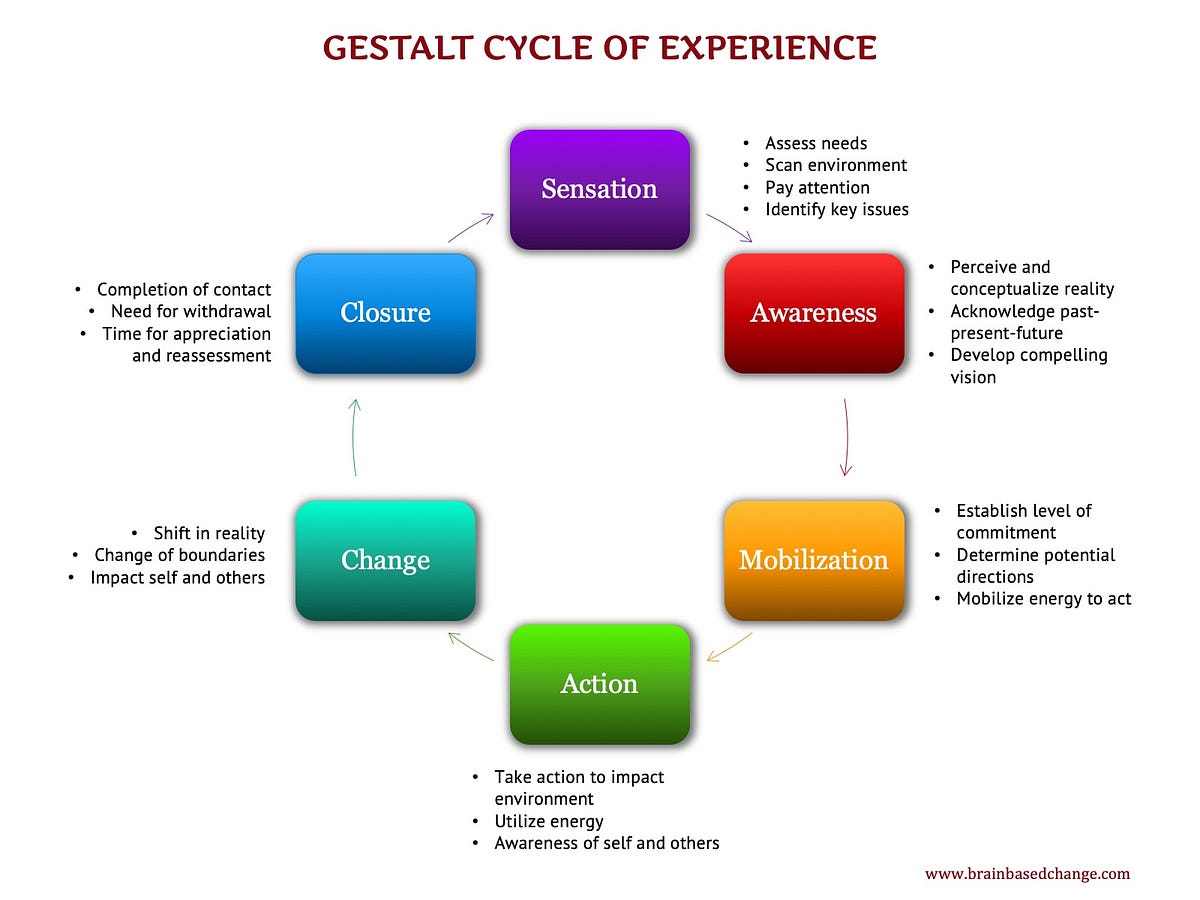

Gestalt Cycle of Experience
Everything we experience in life can be looked at as a cycle. We start at “Sensation” (something happens), and we have to move through all the steps to complete the cycle. We sometimes get in our way.
Arousal refers to the phase where energy and awareness begin to build in response to a sensation or need. It’s the second stage in the cycle, following sensation, where an individual becomes aware of a stimulus or need (e.g., hunger, discomfort, or an emotional urge). During arousal, the person experiences a growing sense of excitement, tension, or motivation to act on that need, mobilizing energy to address it.
For example, if you feel hungry (sensation), arousal might manifest as increased focus on food, a sense of urgency, or physical restlessness, pushing you toward action (like seeking food). In Gestalt theory, this cycle—sensation, arousal, action, contact, resolution, and withdrawal—describes how needs are recognized and met in a healthy process. If arousal is interrupted or suppressed, it can lead to incomplete cycles and unresolved needs.
Desensitization happens when a person suppresses, ignores, or disconnects from sensory experiences (physical or emotional) that would typically initiate the cycle. This blockage prevents the individual from becoming aware of their needs or moving forward in the cycle toward action and resolution. This is quite often a defense mechanism, based on one’s past experiences, trauma, or habitual avoidance, that dulls one’s ability to sense internal or external stimuli fully.
For example:
- Physical desensitization: Not noticing hunger pangs due to chronic stress or distraction.
- Emotional desensitization: Suppressing feelings of sadness or anger to avoid discomfort.
ok, now what
Awareness is the base of the therapeutic process, referring to the conscious, present-moment recognition and experience of one’s thoughts, feelings, bodily sensations, and environment. It involves being fully in touch with the “here and now,” noticing what is happening internally and externally without judgment or avoidance. Awareness is not just about intellectual understanding but an experiential, holistic process that integrates mind, body, and emotions.
Key Aspects of Awareness in Gestalt Therapy:
Responsibility and Choice: Becoming aware empowers individuals to take responsibility for their feelings, actions, and choices, rather than attributing them to external forces. For example, instead of saying, “This situation makes me angry,” a client might recognize, “I feel anger in this moment.” This approach helps clients address their unresolved needs.
Present-Centered Focus: Awareness emphasizes living in the moment, as opposed to dwelling on the past or anticipating the future. Clients are encouraged to notice what they are experiencing right now—sensations, emotions, or thoughts.
Holistic Experience: It involves connecting with the whole self—physical sensations (e.g., tension in the body), emotions (e.g., sadness or anger), and thoughts—rather than fragmenting or suppressing parts of the experience.
Self-Regulation and Growth: Gestalt therapy views awareness as a natural process that promotes self-regulation. By becoming aware of their needs, desires, or unresolved issues (often called “unfinished business”), individuals can make choices that lead to personal growth and integration.
The “Figure-Ground” Process: Awareness in Gestalt therapy is tied to the concept of figure and ground, where certain aspects of experience (the “figure”) stand out against the background of one’s life (the “ground”). Therapy helps clients identify what is in the foreground of their awareness and explore its significance.
In Gestalt therapy, deflection of awareness refers to a defense mechanism or process where an individual avoids fully experiencing or acknowledging their thoughts, feelings, sensations, or needs in the present moment.
The client instead of staying in contact with their authentic experience, they divert their attention or energy away from it, often unconsciously, to avoid discomfort, vulnerability, or conflict. Deflection is one of several “contact interruptions” or “resistances” identified in Gestalt therapy that hinder full awareness and authentic engagement with oneself or others.
Characteristics of Deflection of Awareness:
Deflection manifests as a way to sidestep direct emotional or psychological contact with an experience. Common ways it shows up include:
- Changing the Subject: Shifting focus away from a painful or uncomfortable topic (e.g., joking or talking about something else when a serious emotion arises).
- Intellectualizing: The client will focusi on thoughts or abstract ideas to avoid feeling emotions or bodily sensations (e.g., analyzing a situation instead of experiencing sadness).
- Distraction: Engaging in behaviors like excessive humor, busyness, or superficial conversation to avoid deeper feelings or needs.
- Minimizing: The client will downplay the significance of an emotion or experience (e.g., saying, “It’s not a big deal” when feeling hurt).
- Projection or Displacement: Attributing one’s feelings to others or redirecting emotions onto safer targets to avoid confronting them directly.
Examples of Deflection:
A person might laugh off a therapist’s question about their sadness, saying, “Oh, I’m fine, let’s talk about something else.”
A client feels anger during a session but starts joking or talking about an unrelated topic to avoid the intensity of the emotion.
Someone experiencing grief might focus on practical tasks or intellectual discussions to steer clear of painful feelings.
Mobilisation is the process of activating or engaging a client’s awareness, energy, and resources to facilitate change, growth, or resolution of psychological blocks. It involves helping the client move from a state of stagnation, resistance, or unawareness to a more dynamic, present, and integrated state of being. The term is rooted in the Gestalt focus on the “here and now” and emphasizes bringing the client’s attention to their immediate experience—emotions, sensations, thoughts, and behaviors—to foster self-awareness and action.
Key Aspects of Mobilisation in Gestalt Therapy:
- Awareness and Contact: Mobilisation encourages clients to become fully aware of their present experience and make contact with their environment, emotions, or unmet needs. This might involve noticing bodily sensations, suppressed feelings, or incomplete actions (e.g., unexpressed anger or unresolved grief).
- Breaking Through Resistance: Gestalt therapy views resistance as a natural part of the process but seeks to mobilise the client to move beyond it. For example, a therapist might use techniques like the “empty chair” to help a client express suppressed emotions or confront unresolved issues, thus mobilising blocked energy.
- Experimentation: Expereintal techniques, such as role-playing or guided imagery or bodywork can assist a client’s mobilisation This helps clients actively engage with their feelings and experiences rather than just talking about them.
- Integration of Polarities: This can involve helping clients integrate conflicting aspects of themselves (e.g., the “top dog” vs. “underdog” in internal dialogues). This helps to achieve a sense of wholeness and fluid functioning.
- Action-Oriented Change: The goal is to move the client toward taking responsibility for their own actions while making choices that align with their authentic self. Mobilisation is about empowering the client to act rather than remain stuck in old patterns.
Introjection is one of the key boundary disturbances in the Gestalt cycle, acting as a defensive mechanism where an individual uncritically “swallows whole” external ideas, beliefs, rules, attitudes, or expectations—often from authority figures, culture, or past experiences—without questioning, digesting, or integrating them into personal awareness. This creates rigid, internalized “shoulds” or “musts” that feel like one’s own but actually override authentic needs, leading to self-imposed restrictions and incomplete gestalts.
Where it occurs in the cycle: Introjection most commonly blocks the mobilization stage, where energy should flow freely toward action based on personal awareness. Instead of moving toward one’s true need, the person introjects external standards, stifling excitement or decision-making. It can also interfere earlier in awareness (e.g., during “scanning the field” for relevant stimuli) or ripple through later stages by limiting full contact. For instance, in the hunger example, someone might sense hunger and become aware of it but then introject a rule like “Good people don’t eat after 8 PM,” halting mobilization and preventing action—even if it’s irrational in the moment.
Characteristics and effects:
It involves partial boundary awareness (you dimly sense the idea might not fit) but no full resistance or choice, resulting in resignation or masochistic compliance for a false sense of safety.
As a defense, it protects against perceived threats (e.g., disapproval or loss of control) but impoverishes present-moment contact, fostering shame, anxiety, or disconnection from the self.
In the Gestalt Cycle, the action stage is the dynamic culmination of the preceding mobilization phase, where an individual translates preparation into deliberate, concrete behaviors to pursue and engage the identified need. This is the “doing” phase—shifting from internal readiness to outward expression—allowing the person to bridge the gap between intention and reality.
Actions stage can include thinkgs like reaching for food to satisfy hunger or starting a difficult conversation to resolve relational tension, or planning and executing a task like submitting a job application to address career dissatisfaction.
Disruption of the actions stages due to fear, perfectionism, or external barriers can impede the cycle, leading to a client being stuck with energy or avoidance patterns; in therapeutic contexts, this stage is key for fostering authentic change by encouraging experimentation and risk-taking. Unlike more rigid models, action in Gestalt is emergent and context-specific, promoting organic growth through trial and reflection rather than forced outcomes.
Projection is a specific resistance where a person attributes their own unacceptable thoughts, feelings, traits, beliefs, or impulses to others, objects, or situations, externalizing responsibility to avoid awareness or action. It typically blocks the cycle between the awareness and mobilization stages (preventing the shift to planning and energy-building) or at the action stage (halting outward engagement). By “projecting,” individuals pretend the issue belongs outside themselves, insulating them from risks like rejection or vulnerability, but it ultimately limits freedom, poisons relationships, and traps them in inaction.
How Projection Works as a Block
- In the cycle, after sensing and becoming aware of a need (e.g., a desire for connection), projection derails progress by blaming externals, freeing the person from mobilizing energy or acting.
- It serves as a short-term defense (e.g., avoiding danger) but becomes problematic when unconscious, rationalized, or habitual, leading to distorted perceptions and stalled growth.
Contact: The pivotal “heart” of the cycle—the moment of full, authentic engagement and exchange with the other or the situation. Here, boundaries dissolve momentarily for mutual influence and presence, fostering growth and intimacy (e.g., truly connecting during the conversation, feeling seen and responded to).
Retroflection is one of the primary contact boundary disturbances or blocks in the Gestalt cycle, occurring specifically between the mobilization and action stages. It interrupts the natural outward flow of energy, causing a person to “turn back” or redirect impulses inward toward themselves instead of expressing them externally. This creates a self-directed aggression or suppression, trapping energy and preventing full contact with others or the environment.
Example: If someone feels anger toward a colleague for taking credit for their work, retroflection might lead them to clench their fists tightly (turning the impulse to “hit” outward into self-restraint) or berate themselves internally (“I must be overreacting”) rather than addressing the issue directly.
Key Characteristics:
Involves doing to oneself what one truly wants (or fears) to do to someone else, or vice versa (e.g., biting your tongue instead of speaking up, or self-criticism instead of confronting a boundary violation).
Often manifests as internalized anger, guilt, or self-harm (physical or emotional), where outward-directed energy (like rage or assertiveness) is “stuffed down” or reversed.
Results in stagnation: Mobilization builds tension, but action is blocked, leading to frustration, anxiety, or psychosomatic symptoms.
Relation to Change and Satisfaction
Satisfaction is the end goal of the Gestalt cycle. This marks the resolution of a need and enabling adaptive change by clearing “unfinished business” that might otherwise manifest as anxiety, defensiveness, or repetitive behaviors.
Disruptions—such as desensitization (numbing sensations), projection (blaming others), or fear-based avoidance—can stall the process, preventing satisfaction and perpetuating stagnation.
In therapy the cycle guides interventions to identify and resolve these blocks, promoting emergent change through heightened awareness and authentic contact.
For instance, addressing a stalled mobilization stage in a career transition might involve exploring fears, leading to empowered action and eventual satisfaction.
Egotism is one of the main boundary disturbances in Gestalt therapy, functioning as a defensive mechanism that interrupts the cycle by fostering excessive self-absorption or detachment.
It involves an artificial over-expansion of the ego, where the person becomes a detached observer of their own experiences rather than fully participating in them, blocking authentic contact and spontaneity.
How Egotism Interrupts the Cycle
A client will usally experience egotism typically during the mobilization, action, or contact stages, where relational or environmental engagement is crucial. Instead of flowing toward satisfaction:
- The individual fixates on their own impulses and needs, ignoring external feedback or others’ perspectives.
- This creates a “barrier” of self-centered observation, as if the ego is watching from afar without emotional investment (e.g., someone in a conversation might intellectually analyze their feelings but withhold genuine sharing, stalling contact).
- The cycle halts prematurely, leaving needs unmet and energy unassimilated, often looping back to awareness with unresolved tension.
The client’s egotism often serves as a short-term coping strategy for discomfort like fear of vulnerability but it often stems from much deeper “unfinished business” like a clients past rejections or reinforcing habitual defenses.
Effects of the Egotism Block
- Interpersonal Strain: The clients relationships suffer from perceived selfishness or aloofness, leading to conflicts, isolation, or incomplete connections.
- Personal Stagnation: Repeated blocks hinder growth, fostering patterns of detachment, low spontaneity, and unfulfilled needs (e.g., chronic self-doubt masked as superiority).
- Therapeutic Implications: In therapy or coaching, recognizing egotism involves experiments to heighten awareness and restore contact, such as role-playing to bridge the observer-participant gap, ultimately enabling fuller cycle completion for healthier change.
A client may experience other common blocks like introjection (uncritically swallowing beliefs), projection (attributing one’s traits to others), retroflection (turning impulses inward), deflection (evading direct contact), and confluence (blurring self-other boundaries).
Addressing egotism, like other blocks, supports the therapy’s goal of integrating fragmented experiences into a cohesive whole.
The withdrawal stage (sometimes called “post-contact withdrawal” or part of the “fertile void”) is the concluding phase of the cycle, where you intentionally disengage from the completed gestalt to assimilate what happened, release what’s no longer needed, and return to a state of equilibrium. It’s a restorative “letting go” that prevents overload and prepares the ground for new sensations to emerge—think of it as exhaling after a deep breath or digesting a meal before feeling hungry again.
- Key characteristics: Withdrawal involves emotional and energetic retraction, reflection, and closure. It can feel like boredom, sadness, or calm emptiness, but it’s essential for renewal. In therapy, it’s linked to the “contact/withdrawal cycle” (C/W/C), where incomplete withdrawal (e.g., clinging to past experiences) can lead to stuckness, like chronic boredom or resistance to change.
- Purpose in change: Without withdrawal, the cycle stalls—you might over-identify with the experience, leading to fixation rather than growth. It fosters the “fertile void,” a creative pause where fresh needs can arise.
- Example: After resolving a conflict (contact/satisfaction), you withdraw by journaling or resting, integrating the lesson before tackling a new challenge.
Disturbances in withdrawal, such as premature interruption or avoidance, are common in therapy and can be explored to restore the cycle’s flow. If you’re applying this personally or in coaching, tracking your own cycles can reveal patterns for intentional change.
Confluence is a specific block characterized by a blurring or loss of ego boundaries, where the client mixes indistinguishably with another person, group, environment, or idea, avoiding the pain of separation.
It often happens at the end of the cycle, between the contact/satisfaction stage and withdrawal, preventing proper closure and differentiation. In this state:
- To the client, the sense of “I” dissolves into “we,” leading to over-identification (e.g., losing personal opinions to please others or enmeshing in relationships).
- It serves as a defense against the anxiety of difference, conflict, or loss, but traps energy in unfinished cycles.
- Examples include codependent relationships, groupthink, or suppressing individuality to maintain harmony.
In therapy with the client, the theripist helps by addressing confluence involves experiments to restore boundaries, such as role-playing separation or amplifying differences, to allow healthier contact and withdrawal.
This block is seen as the “final resistance” in the cycle esists the full completion of change by evading individuation.